
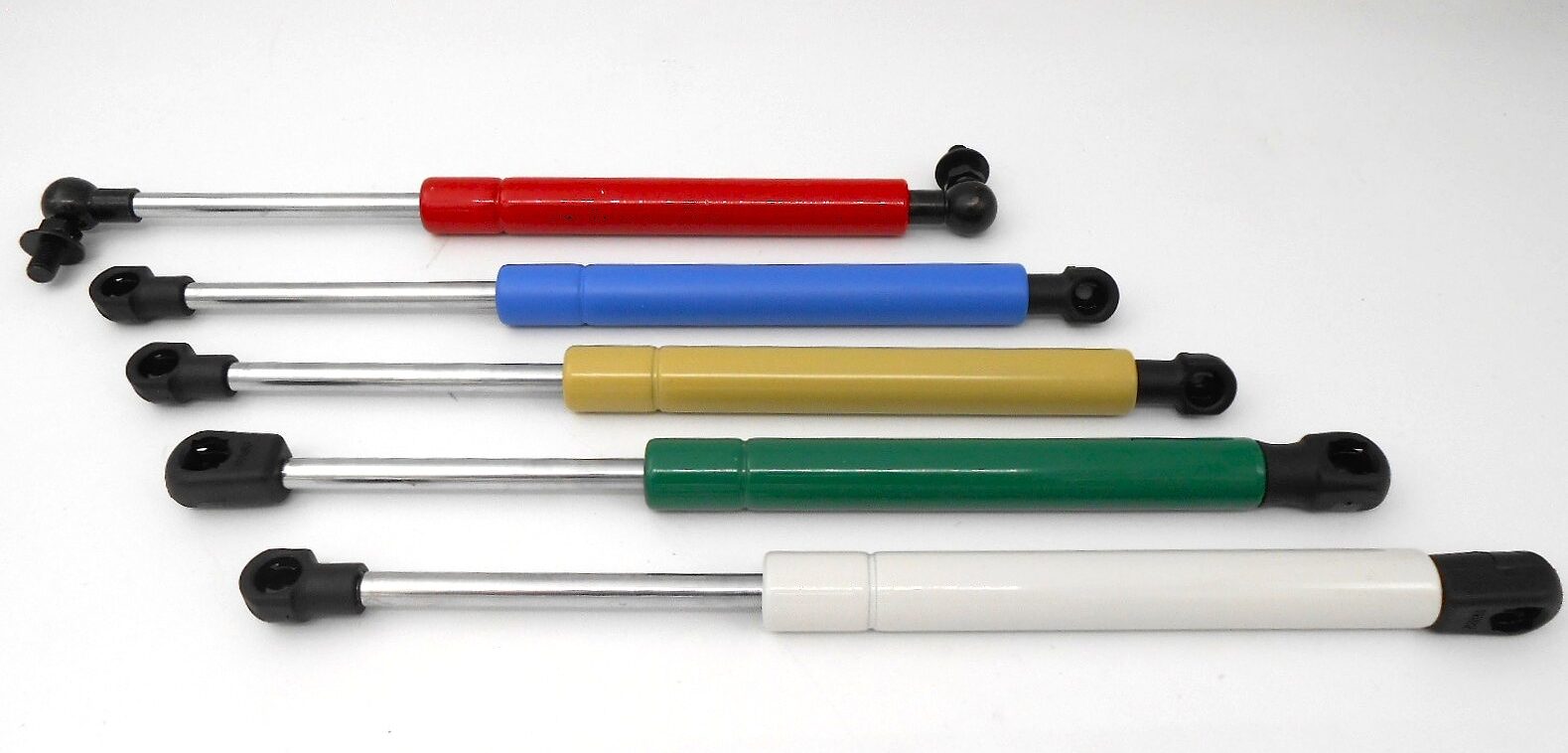
Gas Strut Recharging and Repair
Measured, recharged and verified on our own charging equipment - when replacement is not the right answer.
Gas Strut Recharging Regassing Repair Assessment On Our Own Equipment
Gas strut recharging and repair
Most suppliers have one answer when a gas strut stops holding: buy a new pair. That is often the right answer. But it is not always, and when it is not, being told to replace a sound strut is expensive — particularly if you are running a fleet, maintaining older equipment, or dealing with a size that nobody stocks any more.
We build and operate our own gas spring charging equipment. That means we can measure what a strut is actually producing, and where the unit is sound, recharge it back to specification — or to a different specification if the original was wrong for the job.
This page explains when recharging makes sense, when it does not, and what the process involves.
Why gas struts lose force
A gas strut is a sealed cylinder holding dry nitrogen at high pressure, with a small oil charge to lubricate the rod seal. Nothing wears out in the way a mechanical spring does. What happens instead is simpler: nitrogen migrates past the rod seal, a little at a time, every cycle and every day.
The practical result is that force decays gradually. A strut does not fail on a Tuesday. It gets weaker over four or five years until one morning the door will not stay up, and by then it has usually been marginal for a season.
Three things accelerate it:
- Dust and grit. Particles on the rod get dragged through the seal on every stroke and cut it. This is the dominant failure mode on South African farm and off-road vehicles. Rod protectors are cheap insurance.
- Mounting rod-up. The oil charge drains away from the seal, the seal runs dry, and the leak rate multiplies.
- Side loading. A door that racks as it opens pushes the rod sideways through the seal, scoring both.
None of these damage the cylinder or the piston. That is why recharging works — the expensive parts of the strut are usually still fine.
Inspect it yourself first
Before you send anything in, run this check yourself. It takes five minutes and will tell you most of what you need to know.
- Visual inspection. Look for dents, bends or corrosion on the cylinder body. Any deformation of the bore is terminal.
- Rod condition. Run a fingernail along the rod. It should be mirror smooth. Pitting, scoring or rust means the seal is already compromised and the unit should be replaced.
- Operation check. Extend and compress it by hand. Movement should be smooth. Jerking, sticking or grabbing points to internal damage.
- Leakage test. Wipe the seal area clean, leave the strut rod-down overnight, and check again. A trace of oil film is normal. Oil running down the cylinder is not.
- Force check. Compare how it feels against a known-good strut of the same rating. A proper measurement needs a force gauge, which is part of what we do on intake.
- Mounting hardware. Check the brackets and end fittings for elongated holes, cracks or loose bolts. Worn mountings will destroy a freshly recharged strut.
- Noise. Squealing or knocking during travel indicates internal wear.
If it passes the visual, rod and leakage checks and simply feels weak, it is a good recharging candidate.
Recharge or replace?
| Condition of the strut | Recharge | Replace | Why |
|---|---|---|---|
| Rod clean and unmarked, holds partially | Yes | - | Seal is intact, the strut has simply bled down over time |
| Rod pitted, scored or rusted | - | Yes | A damaged rod will destroy a new seal within weeks |
| Cylinder dented or bent | - | Yes | The piston cannot pass a deformed bore; the strut will bind or leak |
| Oil weeping visibly down the cylinder | - | Yes | The seal has already failed and will not hold a fresh charge |
| Obsolete or discontinued part, otherwise sound | Yes | - | Often the only way to keep older equipment in service |
| Non-standard length or force, custom application | Yes | - | Cheaper and faster than tooling a new custom strut |
| Common stock size, single unit | - | Yes | A new strut usually costs less than handling and recharging one |
| Fleet of identical struts all drifting out of spec | Yes | - | Batch recharging to a known force is far cheaper per unit |
| End fittings damaged but body sound | Yes | - | Fittings are replaced as part of the service |
| Strut of unknown origin with no markings | Assess first | - | We measure the actual force before deciding |
The recharging process
| Stage | What we do | What you get |
|---|---|---|
| 1. Intake and inspection | Visual check of rod, cylinder, seals and end fittings | A pass or fail on whether the unit can be recharged at all |
| 2. Force measurement | The strut is measured on a force gauge against its original specification | The actual current force, and how far it has drifted |
| 3. Report and quote | We tell you what we found and what it will cost | A decision point - no work proceeds without your go-ahead |
| 4. Depressurise and strip | The old charge is safely released and the unit opened | Safe handling of a component pressurised to several hundred bar |
| 5. Seal service | Seals and guides are inspected and renewed where required | A unit that will hold its new charge |
| 6. Recharge | Recharged with dry nitrogen to the specified force | Force set to your specification, not just the original |
| 7. Verification | Re-measured on the gauge and cycle tested | Documented output force for every unit |
| 8. Return | Units marked with their force rating and returned | Struts you can identify on the shelf in two years time |
Who this service is for
Recharging is not the right answer for one dead canopy strut on a common size. It is the right answer in these situations. For a straight replacement on a bakkie canopy, see our canopy gas struts page.
Fleets and workshops
If you run a fleet of identical vehicles or machines, your struts will reach end of life at roughly the same time. Batch recharging to a documented force is substantially cheaper per unit than replacement, and you get every strut back at a known, verified rating rather than a spread.
Obsolete and discontinued parts
Older plant, imported machinery, discontinued vehicle models, specialist equipment — when the original strut is no longer available, recharging the one you have is often the only route that does not involve redesigning the mounting.
Non-standard and custom applications
Where a strut was built to a specific force for a specific machine, recharging preserves that specification. It is also how we correct a strut that was wrongly specified from new: if the original force was too low for the door, we can charge it higher rather than sourcing a different part.
Agricultural and mining equipment
Cab windows, bonnets, access panels and guarding on equipment that works in dust. These struts fail predictably and are frequently non-standard sizes, which makes them ideal candidates for a service cycle rather than replacement.
Safety
Do not attempt to open, drill, cut, weld or burn a gas strut. A gas strut is pressurised to several hundred bar. Releasing that charge without the correct equipment is genuinely dangerous, and gas struts must never be disposed of in a fire or sent to a scrap furnace charged. If you have old struts to dispose of, bring them to us and we will depressurise them safely at no cost.
What we need from you
To quote you accurately we need:
- The struts themselves, or clear photographs of the full length and both end fittings if you want a preliminary view.
- The original force rating if it is still legible on the cylinder, or the application details if it is not.
- What the strut is lifting — the weight and the mounting geometry — if you want us to recommend a different force rather than restore the original.
- Quantity. Batch work is priced very differently to single units.
Struts can be couriered to us as ordinary freight within South Africa. We are at 12 Kelly Road, Jet Park, Boksburg. Contact us first so we can give you a reference and quote the work before you send anything.
Recharging FAQs
Can all gas struts be recharged?
Is a recharged strut as good as a new one?
Can you charge a strut to a different force than the original?
Do you recharge struts you did not supply?
How do I know what force to ask for?
Can you recharge locking gas springs?
What about dampers rather than gas springs?
How long does it take?
Have struts you think are worth saving? Send us photographs and the original force rating, or courier the units in for assessment. We will measure them, tell you honestly whether recharging is worth it, and quote before doing any work.