

Gas Strut Size Calculator
Work out the length, stroke and force rating you need, then find the part number.
Size Your Gas Strut By Length Stroke Force Thread In Four Steps
What size gas strut do I need?
Sizing a gas strut comes down to four numbers: how long it is, how far it travels, how hard it pushes, and what thread is on each end. Get those four right and the strut will run for years. Get one wrong and the lid either will not stay up, or it flies open and tears its own mounting out.
This page gives you the arithmetic, the specification tables for every series we carry, and a calculator that does the sum for you. It applies to canopy doors, toolbox lids, machine guards, cabinet doors, trailer lids, tractor bonnets and anything else that needs a hand staying open.
The calculator
You need a tape measure and a rough weight. Measure the door from the hinge line to the far edge, weigh it (there is a tip in the box below if you cannot get it onto a scale), and set the slider to where the strut will bolt onto the door. The calculator works out the centre of gravity for you.
If you would rather see the arithmetic, it is set out in the next section.
Gas Strut Force Calculator
Two measurements and a weight. Everything else has a sensible default.
Open the door until it is roughly horizontal, rest the far edge on a bathroom scale, and take the reading. For an evenly weighted door the true weight is about twice the scale reading. Support the door while you do this - do not rely on the old struts.
This is an estimate for a top-hinged door or lid. Rubber seal friction, wind loading and anything bolted to the door all add load. Confirm the specification with us before you order.
Step 1: The four dimensions
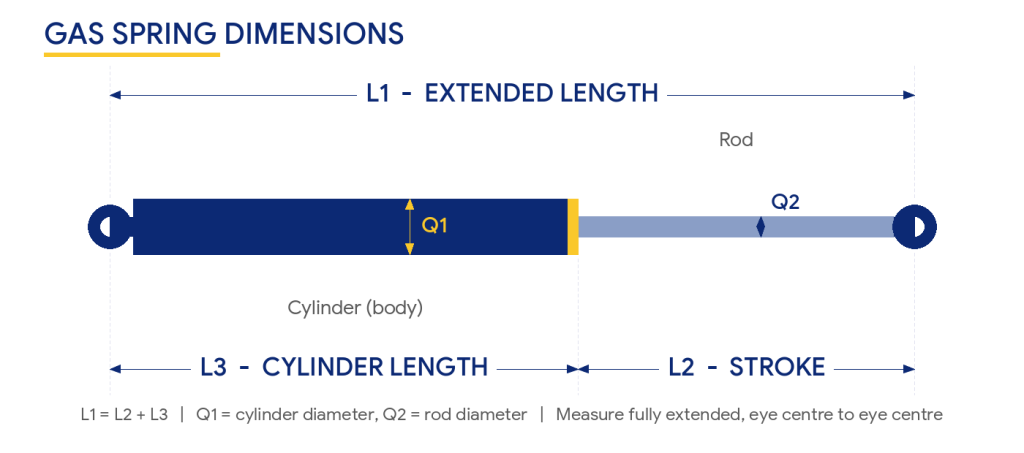
Three lengths define every gas strut. Measure the strut fully extended, from the centre of one mounting point to the centre of the other.
- L1 — extended length. Eye centre to eye centre with the rod all the way out. This is the primary ordering dimension.
- L2 — stroke. How far the rod moves. On our standard series stroke runs at roughly 45% of extended length. Stroke sets how far your lid opens.
- L3 — cylinder length. The body. L1 minus L2.
- Q1 and Q2 — cylinder and rod diameter. Written as a pair, for example 18*8, meaning an 18mm cylinder on an 8mm rod. This sets the maximum force the strut can carry and how much side load it will tolerate.
The most common measuring error by a wide margin is measuring a dead strut while it is compressed. A failed strut will not push itself out. Pull the rod out by hand until it stops, then measure. If you measure it as it sits you will order something roughly half the length you need.
Step 2: The force formula
For a top-hinged lid or door, the force each strut has to provide is:
Force per strut (N) = (W × 9.81 × Dcg) ÷ (n × Dm) × SF
- W = weight of the lid in kilograms
- Dcg = distance from the hinge line to the centre of gravity of the lid, in mm. For an evenly weighted door this is half the door length, which is what the calculator assumes unless you tell it otherwise
- Dm = distance from the hinge line to where the strut mounts on the lid, in mm
- n = number of struts
- SF = safety factor, normally 1.2
For a uniform flat lid, the centre of gravity sits at half the lid’s length from the hinge. If the lid has a heavy edge — a glass panel, a lock assembly, a spare wheel carrier — the centre of gravity shifts toward it and you should measure rather than assume.
Why the safety factor matters. A gas strut loses a small percentage of its charge every year past the seal, and gas pressure falls with temperature at about 0.3% per degree Celsius. A strut sized with no margin will hold on the day it is fitted and sag on the first cold morning of its second winter. The 1.2 factor buys you that margin. Use 1.3 for anything that lives on gravel roads or works in the cold.
Step 3: Worked examples
Example 1 — canopy side door
Glass side door, 10kg, centre of gravity 240mm below the hinge, struts mounted 190mm below the hinge, two struts, standard vehicle safety factor.
(10 × 9.81 × 240) ÷ (2 × 190) × 1.2 = 74N per strut. Round up to the 80N band. Series: SA4000, 18×8, M6 thread.
Example 2 — steel toolbox lid
Chequer-plate lid, 18kg, centre of gravity 300mm from the hinge, struts mounted 220mm from the hinge, two struts, dusty environment so a 1.3 factor.
(18 × 9.81 × 300) ÷ (2 × 220) × 1.3 = 157N per strut. Round up to 200N. Series: SA4000, or SA4100 if the box lives on a gravel road.
Example 3 — tractor bonnet
Bonnet, 45kg, centre of gravity 620mm from the hinge, struts mounted 340mm from the hinge, two struts, 1.3 factor for farm conditions.
(45 × 9.81 × 620) ÷ (2 × 340) × 1.3 = 523N per strut. Round to 600N. Series: SA4100 at minimum, SA6000 preferred for rod diameter and side-load tolerance at this weight.
Example 4 — single strut on a light hatch
Aluminium access hatch, 4kg, centre of gravity 180mm from the hinge, strut mounted 150mm from the hinge, one strut, indoor use so 1.1.
(4 × 9.81 × 180) ÷ (1 × 150) × 1.1 = 52N. Round to 80N, the smallest practical band. Series: SA4000.
Step 4: Check the stroke
Force decides whether the lid holds. Stroke decides how far it opens, and it is the dimension most people forget.
A strut can only move the lid through the arc its stroke allows. If you need a canopy door to swing through 80 degrees and the strut only has 155mm of stroke mounted 190mm from the hinge, it will not get there — the strut runs out of travel and becomes a mechanical stop, which bends rods and tears brackets.
A workable rule for a top-hinged door: the stroke needs to be at least the straight-line distance between the strut’s mounting points measured closed, subtracted from that same distance measured at your target open angle. In practice, if you are replacing like for like, matching the original stroke is correct. If you are designing from scratch, mount the strut further from the hinge to get more opening angle from the same stroke, and accept that this raises the force you need.
Always leave free travel at both ends. Five to ten millimetres at full open and full closed. A strut that bottoms out is being used as a door stop, and that is the fastest way to destroy one.
Step 5: Choose the series
Once you know the force and the length, the series follows. Each of our series is defined by its end thread and its cylinder and rod diameter. Diameter matters as much as force rating: an 18×8 strut technically rated to 700N will not survive long on a 30kg door, because the 8mm rod cannot take the side loading that a heavy door imposes as it swings.
As a rule, if you land near the top of a series’ force range, step up to the next series. The extra cost is small and the strut will last several times longer.
| Series | End thread | Cylinder x Rod | Force range | Extended length range | Typical applications |
|---|---|---|---|---|---|
| SA4000 | M6 | 18 x 8mm | 50 - 700N | 150 - 800mm | Canopy doors, toolbox lids, cabinet and hatch lids, light machine covers |
| SA4100 | M8 | 22 x 10mm | 50 - 1300N | 150 - 1000mm | Heavy canopy and service doors, caravan lockers, seating, medium machine guards |
| SA6000 | M10 | 25 x 12mm | 100 - 2000N | 350 - 1000mm | Trailer lids, bakkie canopies with roof loads, industrial access panels |
| SA6100 | M12 | 28 x 14mm | 100 - 2500N | 350 - 1500mm | Agricultural bonnets and cab windows, large machine guarding, heavy hatches |
| SA6200 | M14 | 28 x 16mm | On request | 350 - 2000mm | Long-stroke industrial applications, large covers and doors |
| SA7000 | M18 | 40 x 20mm | 200 - 4500N | 350 - 2000mm | Truck and bus panels, heavy plant, large industrial covers and platforms |
Full part-number tables with every length, stroke and cylinder length in each series are on our lift gas springs page. If you need a locking strut — one that holds at any point in its travel rather than only fully open — see locking gas springs.
Force by application
If you do not have a scale handy, this table gives typical weights and force requirements by application. Use it as a sanity check on your calculation rather than as a substitute for it — two canopy doors of the same size can differ by 4kg depending on whether the glass is fixed or sliding.
| Application | Typical lid or door weight | Total force required | Struts fitted | Suggested series |
|---|---|---|---|---|
| Kitchen or office cabinet lift-up door | 2 - 5 kg | 60 - 150N | 1 - 2 | SA4000 |
| Bakkie canopy side door | 8 - 12 kg | 300 - 400N | 2 | SA4000 |
| Bakkie canopy rear door | 14 - 20 kg | 500 - 700N | 2 | SA4000 / SA4100 |
| Trailer or toolbox lid | 10 - 25 kg | 400 - 900N | 2 | SA4100 |
| Caravan or camper luggage door | 30 - 45 kg | 1000 - 1600N | 2 | SA4100 / SA6000 |
| Machine guard or access panel | 20 - 60 kg | 700 - 2200N | 2 | SA6000 / SA6100 |
| Tractor bonnet or cab window | 25 - 70 kg | 900 - 2500N | 2 | SA6100 |
| Bus or truck luggage panel | 60 - 150 kg | 2200 - 5500N | 2 | SA7000 |
| Heavy industrial cover or platform | 100 - 250 kg | 3500 - 9000N | 2 - 4 | SA7000 |
Step 6: Confirm the end thread
The last number you need is the end thread, because it determines which fittings will screw on. Our series run M6 (SA4000), M8 (SA4100), M10 (SA6000), M12 (SA6100), M14 (SA6200) and M18 (SA7000).
If you are reusing your existing ball studs, eyelets or clevises, the thread must match exactly. If you are starting fresh, choose the fitting to suit the mounting rather than the other way round:
- Ball and socket — tolerates a few degrees of misalignment and unclips for removal. The default choice for vehicle doors and canopy lids.
- Eyelet on a clevis pin — rigid and cheap, correct only where the geometry is true and stays true.
- Spherical eyelet or rose joint — maximum angular tolerance, for heavy doors that rack as they open.
- Blade or fork fittings — for machine guarding and industrial frames where a bolted, serviceable joint is wanted.
Browse the full range on our end fittings and mounting brackets pages.
Sizing mistakes to avoid
Nearly every warranty return we handle traces back to one of the items below. None of them are the strut’s fault.
| Mistake | What you will see | The fix |
|---|---|---|
| Measured the strut compressed instead of extended | Ordered strut is roughly half the length needed and will not reach the mountings | Always measure fully extended, eye to eye |
| Force too low | Lid creeps down, will not hold in the cold, needs a hand to finish opening | Recalculate with the 1.2 safety factor and round up a band |
| Force too high | Lid flies open, slams against its stop, hinges work loose, corners crack | Drop one force band or move the mounting closer to the hinge |
| Stroke too short | Lid does not open far enough to be useful | Choose a longer strut, or move the mounting points further from the hinge |
| Stroke too long | Strut bottoms out and becomes the door stop, bending the rod | Leave 5 - 10mm free travel at each end of the arc |
| Mounted rod-up | Works for a season, then loses force rapidly and starts squeaking | Remount cylinder-up, rod-down so oil sits against the seal |
| Ignored side loading | Rod becomes scored, strut leaks within months | Use ball joints or spherical eyelets to absorb misalignment |
| Mixed a new strut with an old one | Lid opens crooked, seals leak, frame twists | Always replace in matched pairs |
| Wrong end thread ordered | New strut will not accept the existing ball studs or eyelets | Confirm M6, M8, M10, M12, M14 or M18 before ordering |
Gas strut sizing FAQs
What size gas strut do I need for a canopy door?
Is a higher newton rating better?
How do I measure a gas strut that has failed completely?
Can I use one strut instead of two?
What does 18*8 or 22*10 mean?
Does temperature affect gas strut force?
Can gas struts be mounted horizontally or upside down?
Do you make gas struts to a custom specification?
Can a gas strut be adjusted or recharged?
Still not certain? Send us the extended length, the stroke, the thread size and the weight of what you are lifting, and we will specify it for you. We have been supplying gas springs into the South African canopy, trailer, agricultural and industrial trade since 2009.