
Gas Struts for Bakkie Canopies
Find the right length, the right force and the right part number for your canopy door.
Canopy Gas Struts For Bakkies Canopies Trailers Campers That Stay Up
Choosing a canopy gas strut
A canopy door that will not stay up is almost always a gas strut problem, and it is almost always fixable in twenty minutes with the right part. The difficulty is working out which part. Canopy manufacturers rarely stamp a part number on the strut, the sticker fades within two seasons on a South African bakkie, and a strut that is 20mm too long will bend your door frame while one rated 100N too low will let the door creep down onto your fingers.
This page is the process we use at our Jet Park counter when a customer walks in with two dead struts in a packet. Work through it in order and you will end up with a length, a force rating and a part number. If you want the arithmetic done for you, use our gas strut size calculator. If your canopy is unusual, or you would rather we did it, send us a photo and the measurements and we will identify it for you.
What you will need: a tape measure, and ideally the old strut off the vehicle. If the old strut is missing entirely, skip to the section on sizing from the door itself.
Is it actually the strut?
Gas struts do not fail suddenly out of nowhere. They lose nitrogen slowly past the rod seal, so the force drops a few percent a year until it falls below the weight of your door. That is why the first symptom is nearly always a door that almost holds. Match what your canopy is doing to the table below.
| Symptom | Most likely cause | What to do |
|---|---|---|
| Door creeps down slowly after opening | Nitrogen has bled past the seal; force has dropped below the door weight | Replace both struts, or send them to us for recharging |
| Door drops fast the moment you let go | Total seal failure or a sheared rod | Replace immediately - this is a finger and head injury risk |
| Door will not stay up in cold weather but is fine in summer | Normal gas contraction on a strut already near the end of its life | Replace with a strut rated 10-15% higher, or recharge to spec |
| One side holds, the other does not | One strut failed first, usually the one on the hinge side of the load | Always replace in pairs - a mismatched pair twists the door frame |
| Rattling on dirt roads | Worn ball studs, loose bracket bolts, or an oversized eyelet hole | Replace the end fittings and check the bracket torque |
| Door slams shut in wind | Force too low for the door, or struts mounted too close to the hinge | Recalculate force and check the mounting geometry |
| Rod is pitted, rusted or scored | Dust and grit have cut the rod surface, which then destroys the seal | Replace and fit rod protectors if the vehicle works in dust |
| Door opens too violently | Force too high for the door weight | Drop one force band, or move the mounting point closer to the hinge |
The cold-morning test
Here is a quick diagnostic that costs nothing. Gas pressure falls with temperature at roughly 0.3% per degree Celsius. A strut that holds the door fine at 30°C in the afternoon but lets it sag at 5°C on a Highveld winter morning has already lost most of its reserve. It is not faulty yet, but it will be within a season. If you are heading into the Karoo or up to the Drakensberg for a long trip, replace it before you go rather than after.
Always replace in pairs
This is the single most common mistake we see. A canopy door with one new 200N strut and one four-year-old strut that has drifted down to 140N does not open evenly. The door twists on its hinge line, the glass seal loads unevenly, and within a few months you have a leaking door and a cracked corner. Struts are cheap. Door glass is not.
Step 1: Measure the strut
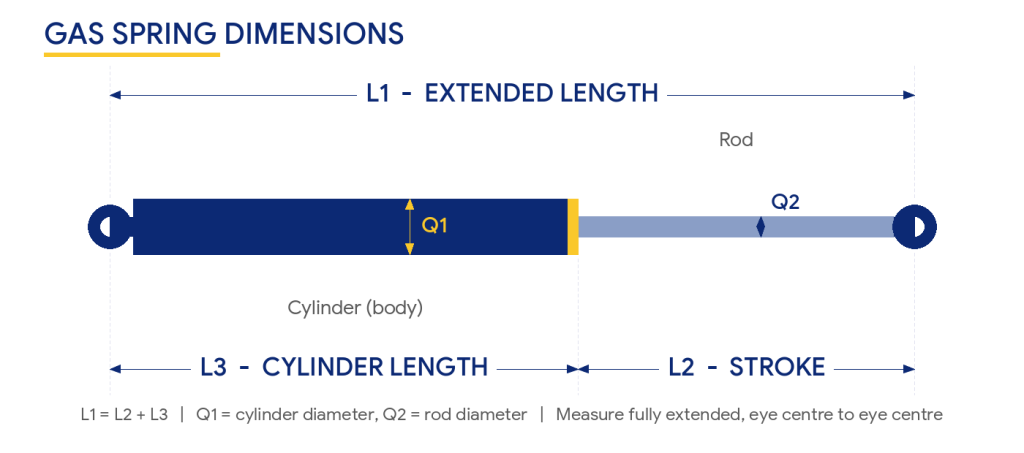
Every gas strut has three dimensions that matter. Get these right and the rest is force selection.
- Extended length (L1) — measured eye to eye, or ball centre to ball centre, with the strut fully extended. This is the number that determines whether the part fits at all.
- Stroke (L2) — how far the rod travels. On our struts this runs at roughly 45% of the extended length. Stroke determines how far your door opens.
- Cylinder length (L3) — the body of the strut. Extended length minus stroke.
Measure the old strut fully extended, not compressed. A compressed strut on the bench will read roughly 55% of its true length and will send you to entirely the wrong part number. If the old strut has lost all its gas and will not push itself out, pull it out by hand until it stops, then measure.
Also note the end fitting thread. Our SA4000 series uses an M6 thread at each end, the SA4100 series uses M8. If you are reusing your existing ball studs or eyelets, the thread must match. If you are not sure, bring the old fitting in or photograph it next to a ruler.
Step 2: Match the length to a part number
If the old strut is missing
Measure the vertical height of the canopy door opening, then work off the table below. As a rule of thumb, the extended strut length for a top-hinged canopy door sits between 75% and 90% of the door height. Fit the strut so that at full extension the door sits at the angle you actually want — not so far back that the strut becomes the door stop, which is what kills mounting brackets.
| Measured strut length (eye to eye, extended) | Stroke | Typical canopy door height | SA4000 series part (M6, 18x8) | SA4100 series part (M8, 22x10) |
|---|---|---|---|---|
| 300mm | 130mm | 350 - 400mm | SA40422 | SA4138 |
| 350mm | 155mm | 400 - 470mm | SA4023 / SA4043 | SA4140 |
| 400mm | 180mm | 470 - 540mm | SA4044 | SA4141 |
| 412mm | 186mm | 480 - 550mm | SA4323 | SA4141 |
| 450mm | 205mm | 540 - 610mm | SA4074 / SA4045 | SA4142 |
| 465mm | 201mm | 550 - 630mm | UL5194 | SA4142 |
| 500mm | 230mm | 610 - 680mm | SA4046 | SA4143 |
| 550mm | 250mm | 680 - 750mm | SA4047 | SA4144 |
| 600mm | 275mm | 750 - 820mm | SA4048 | SA4145 |
Step 3: Work out the force
Length gets the strut to fit. Force gets it to work. Force is quoted in newtons (N) and is stamped on the cylinder of every strut we supply.
The arithmetic for a top-hinged door with two struts is:
Force per strut (N) = (door weight in kg × 9.81 × distance from hinge to door centre of gravity) ÷ (2 × distance from hinge to strut mounting point) × 1.2
The 1.2 is a safety factor. It covers seal losses over the strut’s life, cold mornings, and the extra load of a wet canvas or a roof-rack awning bolted to the door. Skip it and you will be back here in eighteen months.
Worked example: a standard double-cab canopy side door
A glass side door on a Hilux-sized canopy weighs about 10kg. The hinge runs along the top edge. The centre of gravity sits roughly 240mm below the hinge line. We are mounting the struts 190mm below the hinge.
Force per strut = (10 × 9.81 × 240) ÷ (2 × 190) × 1.2 = 74N per strut.
In practice you would fit 80N or 100N struts here, because the calculation assumes a perfectly balanced door and ignores the seal friction on a rubber-glazed frame. Round up to the next standard band, never down.
Worked example: a heavy rear service door
A steel rear door on a service body weighs 26kg, centre of gravity 400mm from the hinge, struts mounted 300mm from the hinge.
Force per strut = (26 × 9.81 × 400) ÷ (2 × 300) × 1.2 = 204N per strut.
That is a 250N strut in the SA4100 series — the 22×10 body, because a door this heavy will destroy an 18×8 rod over a few thousand cycles even though the force rating is technically available in that series.
If you do not want to do the arithmetic
Use the table below as a starting point, then phone us. We would far rather spend three minutes on the phone than have you fit the wrong pair.
| Door type | Approx. door weight | Force per strut (pair fitted) | Total force | Recommended series |
|---|---|---|---|---|
| Small side-access hatch, single skin aluminium | 4 - 6 kg | 80 - 120N | 160 - 240N | SA4000 (18x8) |
| Standard bakkie canopy side door, glass | 8 - 12 kg | 150 - 200N | 300 - 400N | SA4000 (18x8) |
| Large canopy side door, glass and frame | 12 - 16 kg | 200 - 250N | 400 - 500N | SA4000 (18x8) |
| Rear canopy door with glass and wiper | 14 - 20 kg | 250 - 350N | 500 - 700N | SA4000 or SA4100 |
| Heavy-duty steel or composite service door | 20 - 30 kg | 350 - 500N | 700 - 1000N | SA4100 (22x10) |
| Full-height camper or caravan luggage door | 30 - 45 kg | 500 - 800N | 1000 - 1600N | SA4100 or SA6000 |
| Toolbox lid, horizontal, top hinged | 5 - 15 kg | 100 - 300N | 200 - 600N | SA4000 (18x8) |
Step 4: Mount it correctly
Two struts of the correct length and force will still fail early if they are mounted badly. Three rules cover most of it.
Cylinder up, rod down
Mount the strut so that in its normal resting position the cylinder body is uppermost and the rod points downward. Gas struts carry a small oil charge that lubricates the seal. Rod-down keeps that oil sitting against the seal. Rod-up drains the oil away from where it is needed and the seal dries out, which is the single biggest cause of premature failure we see on canopies. On a canopy door this usually means the cylinder end bolts to the door and the rod end bolts to the body.
Never bottom out, never top out
The strut should not become the door stop at full open, and it should not be fully compressed when the door is shut. Leave 5 to 10mm of travel at each end. A strut used as a mechanical stop transmits the full slam load through the rod and the mounting bracket, and it will bend the rod or tear the bracket out of the door skin.
Keep the strut in one plane
The strut must swing in a single plane through its whole arc. Any side loading on the rod scores it, and a scored rod cuts the seal. If the door racks slightly as it opens, use ball-and-socket end fittings rather than eyelets — a ball joint tolerates a few degrees of misalignment, an eyelet on a clevis pin does not.
End fittings and brackets
The strut is half the job. The end fittings and brackets determine whether it survives a corrugated dirt road.
- Steel ball joints — the standard canopy fitting. Tolerates misalignment, snaps on and off for door removal. Available in M6 and M8 to match the SA4000 and SA4100 series.
- Nylon end fittings — lighter and quieter, good for light hatches and interior lids, but not for a heavy door on a working bakkie.
- Galvanised steel end fittings and eyelet end fittings — for bolted mountings where the geometry is fixed and true.
- Rose ball joint / spherical eyelet — where you need real angular tolerance on a heavy door.
For brackets, our GS-series canopy brackets cover the common mounting situations: the GS100 glide runner, the GS200 angle bracket, the GS300 double angle, the GS400 90° angle and the GS500 triangular plate for spreading load into a thin door skin. There is also a universal mount bracket where nothing standard fits.
If the strut is mounting into a fibreglass or thin aluminium canopy door, use the triangular plate. A bare angle bracket bolted through a 1.2mm skin will pull through within a season of corrugations.
Fitting a canopy strut
- Prop the door open properly. Use a timber batten or have someone hold it. Do not rely on the old struts — they are the reason you are here.
- Remove one strut at a time. Ball fittings pop off with a flat screwdriver under the spring clip. Do not lever against the glass.
- Compare old and new side by side before you fit anything. Extended length, thread size and fitting type must all match.
- Fit the new strut cylinder-up. Check the orientation before you tighten anything.
- Check the travel by opening and closing the door slowly by hand. There should be free travel left at both ends.
- Torque the bracket bolts and check them again after the first week of driving. Canopy vibration loosens fasteners.
Never puncture, cut, burn or dispose of a gas strut in a fire. They are pressurised to several hundred bar. If you need to scrap old struts, bring them to us and we will depressurise them safely.
Recharge or replace?
Most suppliers only sell you a new pair. Because we build and run our own charging equipment, we can often recharge a strut back to its original specification instead — provided the rod and seal are still sound.
Recharging makes sense when: the rod is clean and unpitted, the body is straight and uncorroded, there is no significant oil weeping around the seal, and the strut is an unusual size or an obsolete part you cannot easily replace. It is particularly worth doing on fleets, where you may have forty identical struts all drifting out of spec at the same time.
Replace instead when: the rod is pitted or scored, the body is dented, there is oil visibly running down the cylinder, or the strut is a common stock size where a new pair costs less than the handling.
If you are unsure, send them to us. We will measure the actual force against the original specification and tell you honestly which way to go.
Canopy gas strut FAQs
How do I know what force my canopy struts are?
Can I fit a stronger strut than the original?
Why did my new struts only last a year?
Do I need to replace the brackets too?
My canopy door has one strut, should it have two?
Do you supply struts for a specific canopy brand?
Can I courier struts to you for recharging?
What is the difference between a gas strut, a gas spring, a gas shock and a gas lift?
Not sure which strut you need? Send us the extended length of the old strut, the thread size, and a photo of the door. We will come back with a part number and a price. We are at 12 Kelly Road, Jet Park, Boksburg, and we supply nationwide.